
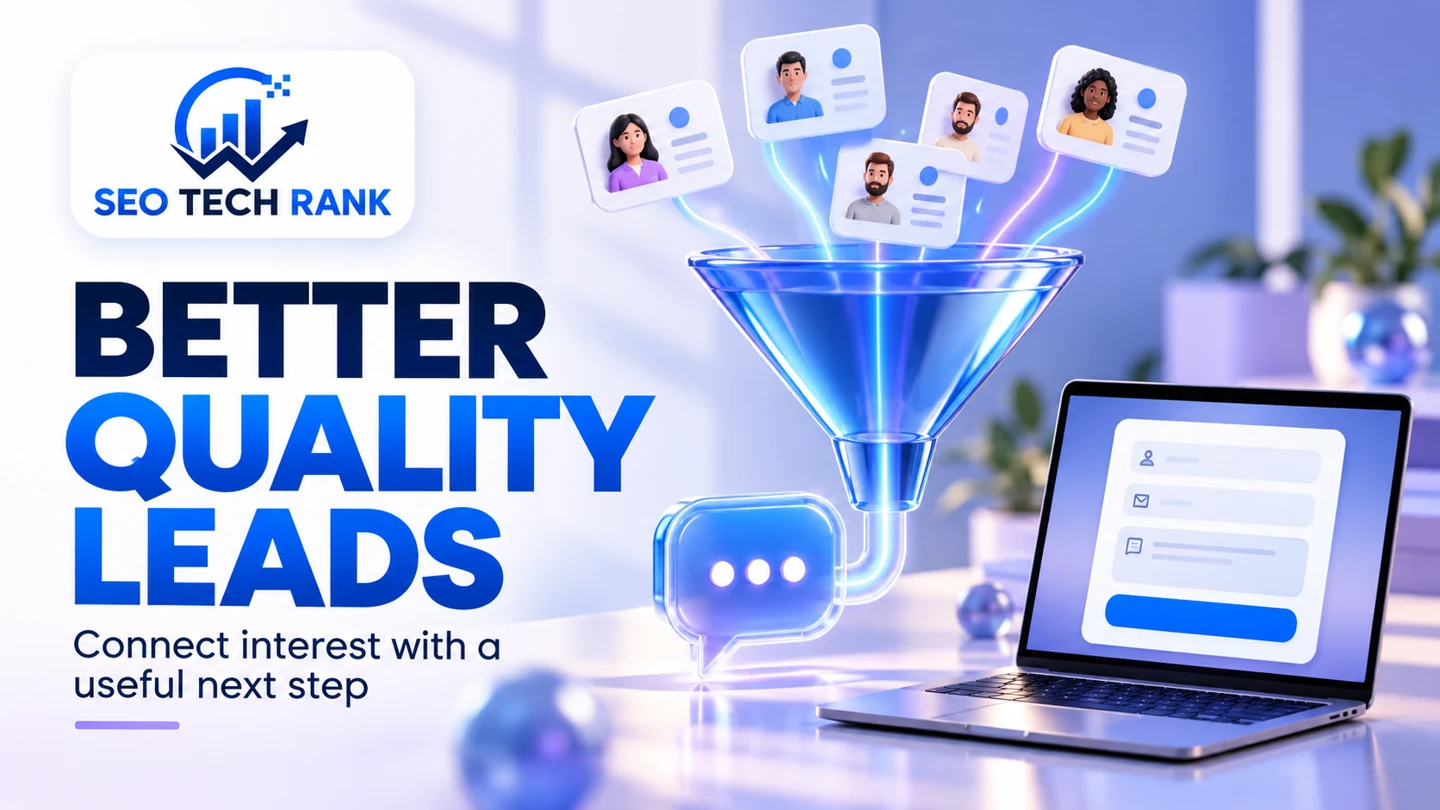
Lead generation services should connect marketing activity with enquiries the business can assess and answer. More submissions are not automatically more opportunity. A form can attract the wrong requests, a campaign can overpromise and a useful enquiry can be lost during follow-up.
Start by defining what a suitable lead means for your business. The answer should guide the offer, campaign, landing page and reporting. Without that shared definition, marketing and sales can disagree while both believe they are doing their job.
Define qualification before choosing a channel
Record the service required, relevant customer type, genuine service coverage and any practical limits. Decide what the team needs to know at the first contact and what can wait for a conversation.
Avoid asking for every possible detail in a form. An early enquiry is not a complete customer record. Collect information because it supports a clear next step, and explain what happens after submission.
Match the offer to the problem
A campaign promising a free assessment should lead to an actual assessment process. A product enquiry should make the product and availability clear. Vague offers can increase response volume while leaving the team unable to identify useful opportunities.
Write the offer in ordinary language and state relevant conditions. If a consultation is introductory rather than a complete strategy, say so. Do not use a limited-time claim unless it reflects a real offer with accurate terms.
Choose one primary conversion path
Calls, forms and messaging can all be suitable, but each needs an owner. Decide which route best fits the enquiry and the team's response process. Give alternatives where useful without presenting a page full of competing instructions.
The SEO vs PPC guide can help frame channel decisions. Neither channel solves an unclear offer or an unavailable sales team. Check the destination before increasing acquisition spend.
Build a landing page that answers decision questions
Explain who the service is for, what is included and how the next step works. Use accurate evidence and specific business facts where available. If there is no verified case study, do not substitute an invented result.
Keep the form near enough to the explanation that a visitor understands what they are requesting. Landing page development should include content structure and functional testing, not only a visual mockup.
Make forms useful and dependable
Use visible labels, understandable validation and a clear success message. Test required fields, invalid input and submission delivery. A visitor should not be left wondering whether clicking the button worked.
Spam protection should preserve legitimate access. Review the experience on a phone and with keyboard navigation. Keep server-side validation and existing security controls intact; a visible checkbox alone does not secure a form.
Set a responsible measurement boundary
Define events consistently: submission, accepted enquiry, qualified opportunity and sale are different stages. Avoid sending personal contact details into ordinary analytics events. Keep the necessary customer record in an appropriately controlled system.
Google's guidance on avoiding personally identifiable information in Analytics is relevant when reviewing event names, page URLs and form tracking. A useful report does not require exposing the message someone sent.
Design the handoff before the campaign launches
Assign an owner for new enquiries and an alternative when that person is unavailable. Record the request, source where reliably known, contact attempts and next action. The process should work even if the original campaign manager is away.
Use marketing automation only where it supports a defined workflow. An automatic notification is not proof that a person read, understood or responded to the enquiry.
Use feedback to improve the marketing
Ask the responding team to classify unsuitable requests using a short, consistent set of reasons. A request may concern the wrong service, an unsupported area or a misunderstanding of the offer. Those patterns can guide changes to targeting and page content.
Do not exclude difficult feedback from the report merely to make campaign performance look stronger. Equally, separate a poor marketing match from an operational failure to contact a suitable prospect.
An illustrative workflow
Consider a hypothetical installation business that receives many incomplete requests. The team could clarify the service area, show the information needed for an estimate and ask one relevant qualification question. It could then record whether accepted enquiries reach a conversation.
This is a proposed diagnostic approach, not a client result. The appropriate fields and response process would depend on the real business, its customers and any applicable privacy requirements.
Review quality alongside cost and volume
Compare acquisition cost with a clearly defined stage. A low cost per form may be unhelpful if most requests cannot be served. A smaller volume may still need investigation before it is labelled a better campaign.
Review lead generation services against a brief that covers the offer, destination, qualification, ownership and reporting. A practical project makes these connections visible so the business can improve the whole journey instead of optimising a submission count in isolation.