
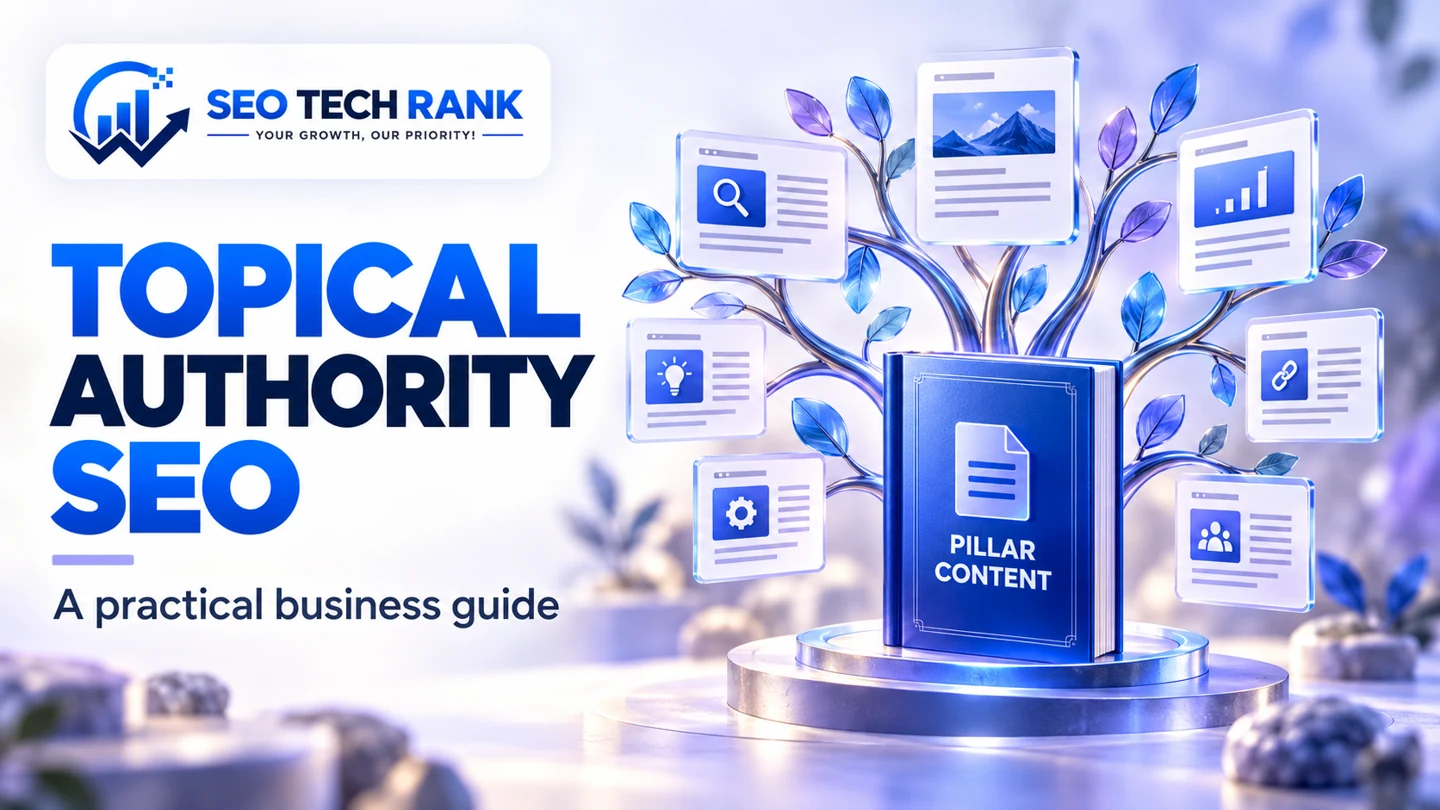
Topical authority SEO is a planning term for building a coherent body of useful information around subjects the business genuinely understands. It is not a public Google score that can be increased by publishing a fixed number of articles.
A strong topic library answers related customer questions, shows how the answers connect and remains accurate over time. The objective is better coverage and clearer decisions, not producing the largest possible cluster.
Define a useful subject boundary
Start with an area the business can serve and explain. A website development agency might cover planning, implementation, ownership and maintenance. It does not need to publish unrelated lifestyle articles merely because a tool finds large search volumes.
Write down what the library includes and excludes. Boundaries prevent research from expanding into subjects where the business lacks useful information or the capacity to maintain what it publishes.
Map questions rather than article counts
List the decisions customers face before, during and after purchase. Identify which questions belong on a service page, comparison, implementation guide or support resource. Check the existing inventory before commissioning anything new.
The content marketing guide covers editorial operations. Topic mapping adds a relationship view: which answer prepares the reader for another, and where does the service page fit?
Choose a pillar page for navigation value
A pillar should introduce the subject and guide readers to deeper resources. It should not repeat the complete body of every supporting article or become an indiscriminate directory of links.
Use descriptive summaries that explain why a supporting guide is relevant. Keep the main page useful on its own. A reader should understand the subject even if they do not open every destination.
Make supporting articles distinct
Give every brief a central question. A keyword research guide and a search-intent guide can complement each other when the first explains research and mapping, and the second explains the decision behind a query.
If two drafts keep repeating the same answer, reconsider the split. Consolidation can be more useful than maintaining competing pages just to satisfy a planned cluster size.
Add evidence the business can support
Use actual process details, verified business facts and clearly labelled illustrative examples. Invite knowledgeable reviewers to identify missing conditions. Do not create an author biography or client result simply to make the library look established.
Google's helpful-content guidance is an editorial reference. Treat expertise as something demonstrated through reliable work, not a badge added to a template.
Design links around learning paths
Connect foundational explanations with relevant deeper guides and practical next steps. A link should help the current question. Repeating a full cluster in every paragraph creates noise rather than a useful learning path.
The internal linking strategy guide explains implementation. Keep links current when content moves and identify pages that receive no meaningful references from elsewhere in the site.
Establish maintenance ownership
A topic library creates an ongoing responsibility. Track source changes, withdrawn services and outdated examples. Review pages based on subject volatility and business importance rather than changing dates without changing content.
A hypothetical software-selection cluster might require frequent checks of product capabilities, while a basic planning checklist may remain useful longer. The right review schedule follows the information, not a universal freshness rule.
Measure the library without inventing an authority score
Review coverage gaps, useful discovery, navigation and appropriate customer actions. Keep platform-specific visibility observations separate from claims of overall authority. More articles do not prove more expertise.
Discuss SEO services with a clear topic boundary and realistic review capacity. A maintainable library supports readers because its articles are distinct, linked and dependable—not because a diagram contains many circles.